At the time of writing, the outcome of the Czech local government elections last month (9-10 October 2026) has been almost completely overshadowed by a different political controversy. Known in brief as “4:36” – the moment in the early hours of Saturday morning on 24 October when the vote passed in Parliament – it represents the latest stage by the current government of populist prime minister Andrej Babiš to end concession fees for Czech Television and Czech Radio broadcasting and bring both media under direct state control through the public budget. In other words, imposing the same deadening, stultifying control familiar across the wider region, from the disturbingly close example of Slovakia through Orbán’s Hungary up to Russia or Azerbaijan.
Perhaps – hoping against hope – the still-powerful cultural memory of 1989, of massive demonstrations in the November chill, maintains enough strength across the generations to counteract the malign intentions in power. Yet the culture-war demagogy is being waged on a wider front. No less disturbing is the recent admonition by the Ministry of Culture to keep publicly funded cultural publications “apolitical”. Of course, this blatant authoritarianism has been opposed by the great majority of literary and artistic journals, yet for open censorship to become enforceable state policy only shows how far the democratic rot has gone.
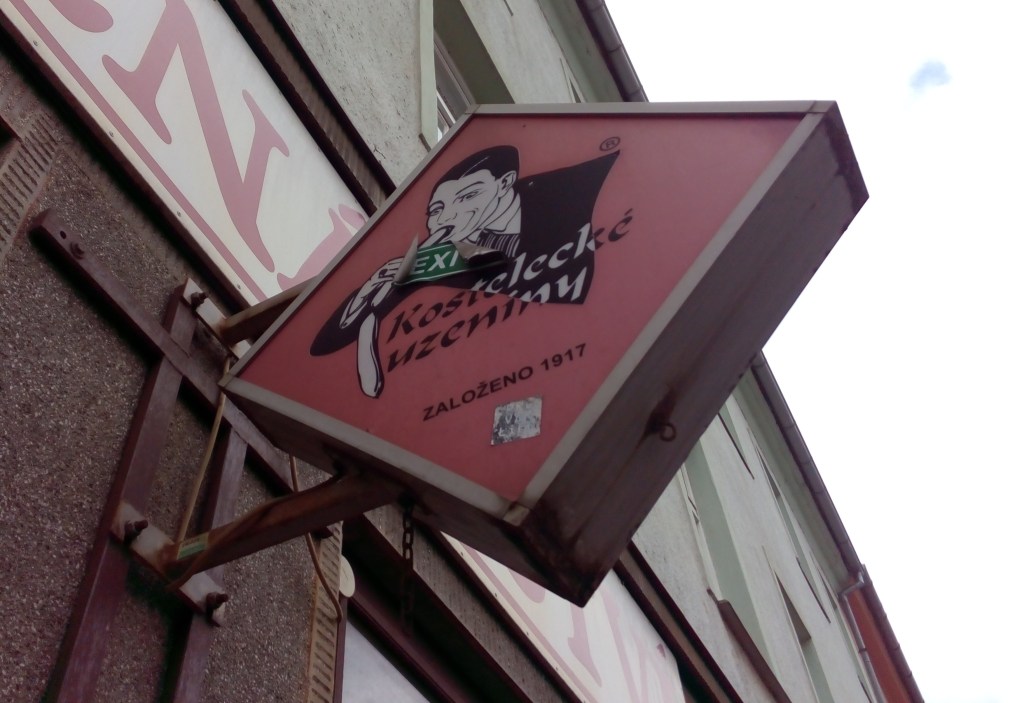
Hot dogs from Kostelec – the icon of Andrej Babiš’s business empire
Keeping in mind that Concrete Eye receives zero public subsidies and strives to maintain the link with pre-1989 samizdat as a worthwhile reserve of inspiration in increasingly dark times, we will display our solidarity by continually violating this requirement. Our independence is a privilege, and in full awareness of it we will always defy any attempts to misuse the law into depoliticizing culture.
With that principle in mind, let us turn toward municipal politics as they seem likely to evolve in the next few years. Perhaps most important is to look away from the attention-grabbing metropolis of Prague (though not to dismiss it entirely) and bring to wider awareness the surprising range of ways that the regions – and especially the oft-overlooked cities of the post-industrial rustbelts – are responding to the challenges of environmental destruction, economic disinvestment, oligarchic financialization, racism and more.
As it happens, two urban areas – overwhelmingly faced with a narrow gamut of reactions between disregard and contempt from metropolitan elites – offer the most interesting paradigms for discussion. One is Ústí nad Labem in North Bohemia, often used as a physical synecdoche for all the ascribed social pathologies of the anomic and “unrooted” industrial Sudetenland. The other, close to the easternmost corner of the national boundaries, is Ostrava, a mining-and-metallurgy showplace of last-century heavy industry now making significant efforts toward a new “eds-and-meds” future. Both cities, moreover, have been the subject of previous discussions on Concrete Eye, though examined more in terms of their material fabric than their socio-human public spheres. The present contribution, though brief, necessarily simplistic and unavoidably superficial, aims to outline precisely this dimension – not directly physical but essential for future built trajectories – of municipal government, in the tradition of “turning local zoning battles into high revolutionary drama”. And, of course, the realities on the ground in both cities are far removed from any simplistic morality play of civic versus populist, past versus present, activism versus spatial (in)justice….
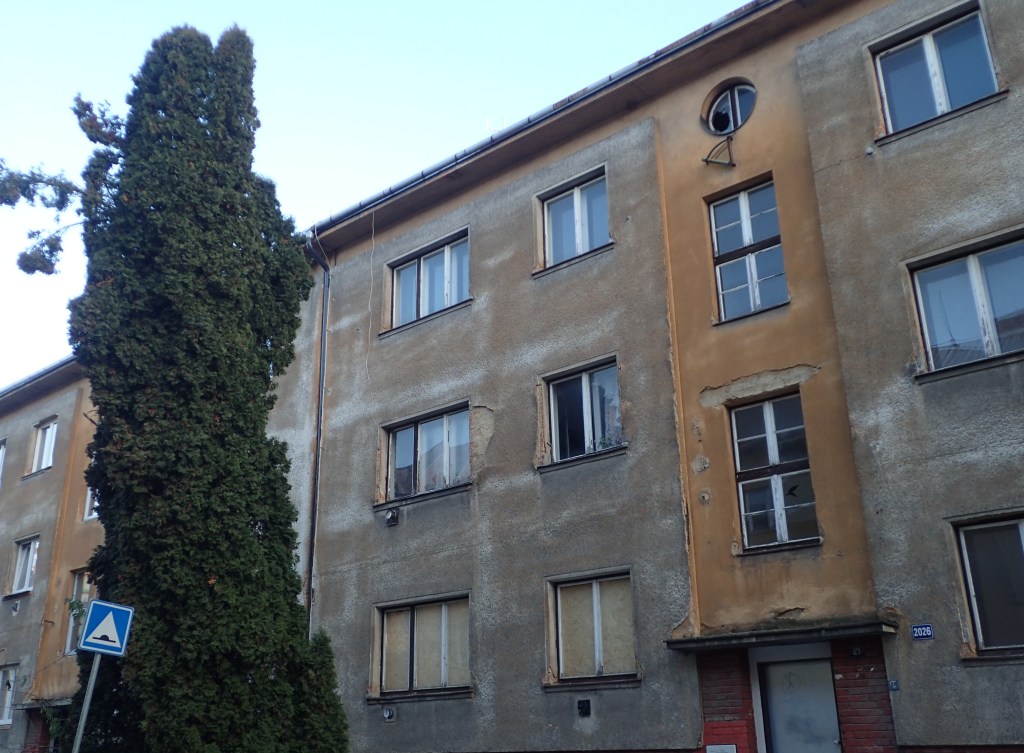
Ústí nad Labem offers the better starting point for the extremely unusual, indeed unexpected situation it faces now. The city’s massive electoral upset saw the end of the longstanding dominance of ANO, the party of Babiš and currently the strongest one in the national parliament, to Jedno Ústí (One Ústí), a broad-based coalition of parties that in conventional divisions range from centre-left to centre-right but, in the current populist-oligarchic situation, style themselves as “democratic”. Against the inertia of ANO governance and the party’s clear expectation of its permanence, Jedno Ústí focused strictly on an apolitical message of infrastructure, fiscal probity, and general quality-of-life issues. This coalition’s success appears inevitable less through hindsight than simply eyesight – eyes that can perceive the decay of public spaces and amenities over the past decade or more, and the political hay to be made from highlighting it. Most galling, to judge from online discussions, was the massive hole in the city’s central square, Mírové náměstí, the remnant of a building project abandoned 17 years ago and leaving its own “hole” of roughly 73 million CZK in the city budget.
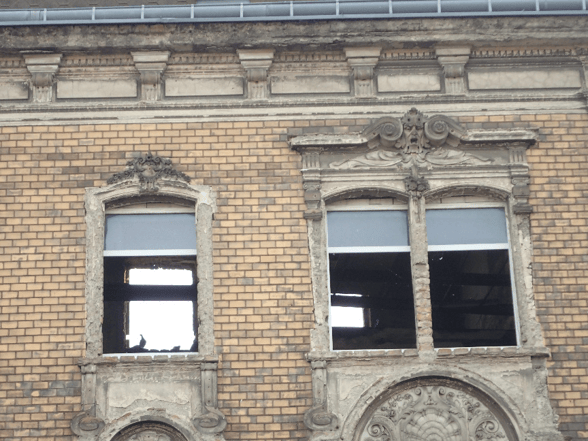
Empty building in Ústí nad Labem-Trmice
In certain respects, Jedno Ústí’s victory echoes in miniature the defeat of Viktor Orbán and the declaredly illiberal FIDESZ system by Péter Magyar and the Tisza Party: overturning an entrenched political hegemon and, more significantly, the resigned cynicism of the voting public that helped the hegemon entrench itself far more effectively than its own actions. A movement based on positive achievements and collective improvements at least offers a different model of thinking beyond the nebulous fears and resentments toward elites, Roma, immigrants, environmental legislation, and all the other perennial scapegoats. And it is absolutely worth mentioning the appearance of institutions in the city itself, both state and civic, that in the morass of economic decline and brain-drain provide “islands of positive deviation” – recalling the oft-cited phrase of the Slovak sociologists Soňa Szomolányiová and Martin Bútora from the final years of Communist rule. How the current coalition will govern remains to be seen: the social and ecological challenges of North Bohemia are enormous, while the technocratic-elitist background of the “democratic” alternative and its unshakably naïve faith in free-market nostrums hold back any excessive optimism. Still, with the ever-present threat of a “Carpathian” solution (i.e., the dominance of the Fico-Orbán national-populist vision), hope should be grasped wherever available.
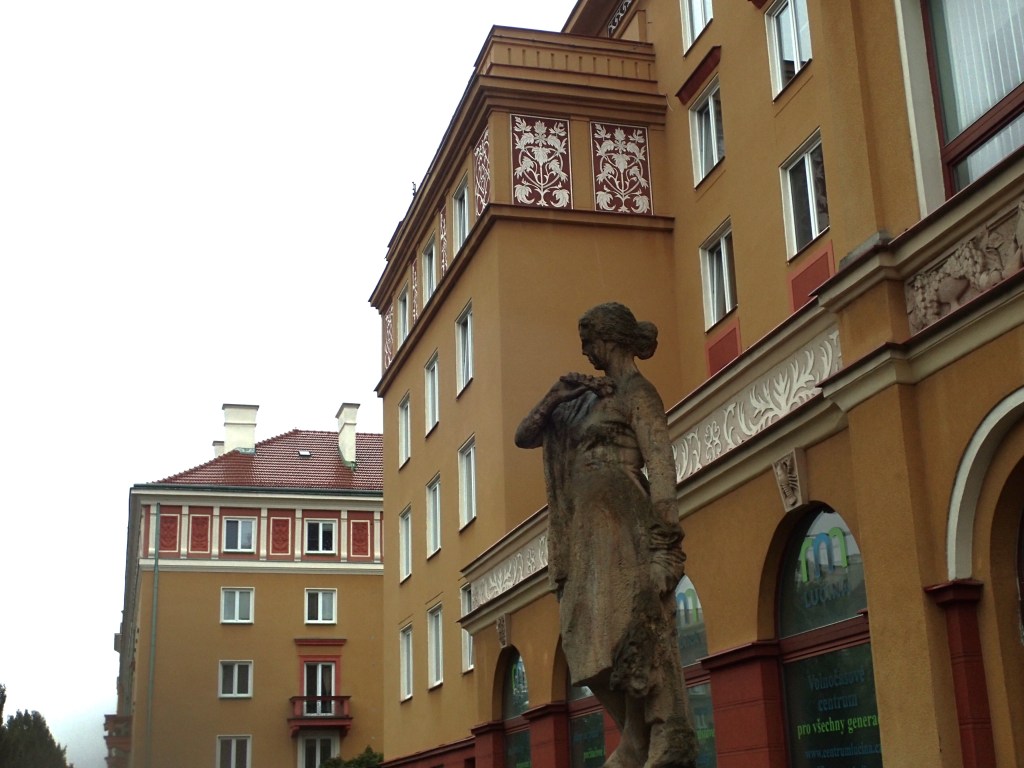
Ostrava, by contrast, presents almost the opposite picture: the largest urban area where ANO and indeed the wider Babiš-coalition with the far-right Direct Democracy (SPD) and Motorists still hold power. The surprising success of “cynico-populism”, as we might term it, might be interpreted as indicating far worse conditions of decay, blight, racist and classist resentments, and other toxic ingredients in the Babiš political cocktail – yet compared to North Bohemia, Ostrava and its wider region (extending to the satellite towns of Bohumín, Karviná, Orlová and the bizarre Socialist-Classicist hallucination of Havířov) could easily appear better off. From the exemplary fleet of all-electric transport to the impressive public developments, e.g. the university buildings in Černá Louka, the “Black Cube” regional library, not to mention the concert hall for the Janáček Philharmonic, it is undeniable that European Union largesse is showing results beyond the wetting of beaks among local notables.
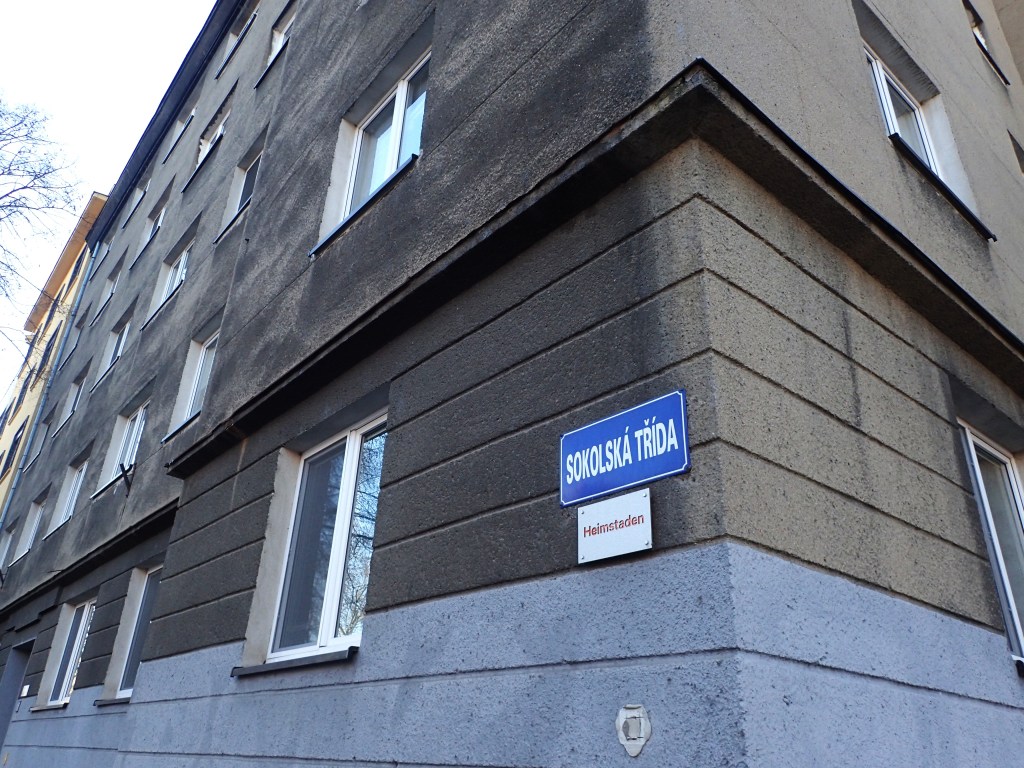
Yet at the same time, these phantasmagoria of sleek prestige and demographic aspirations are rising alongside deserted city-centre streets, ill-planned highway-spaghetti, denuded post-industrial ruinscapes, or a sad archipelago of Roma ghettos – not to mention the targeted efforts by city officials against Bedřiška, the one functioning integrated settlement, as reported here. And, as is too often forgotten, the corporate stranglehold on the housing market: Ostrava’s housing stock, having overwhelmingly been constructed by the state mining corporation OKD, was never privatized directly to its tenants in the 1990s but retained as a company asset until its sale to various institutional investors, the current owner now the Swedish real estate giant Heimstaden. Instead of coming together to form any post-populist political force, however ramshackle or contradictory, Ostrava’s local intelligentsia appear to remain mentally caught in the framework of Brussels-financed economic uplift – or in somewhat cruder terms, the fantasies of technocratic-flavoured gentrification still persisting from the first years of EU membership. And for a clear majority of the city’s voters, the appeals by purported democratic forces to the ideals of 1989 ring worse than hollow, recalling not civil liberties but the realities of state-enabled asset theft.
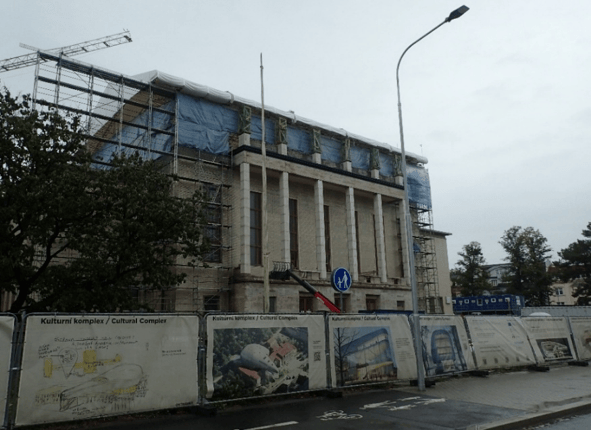
Ostrava’s House of Culture with the Steven Holl addition visualized on the fence.
Far more should be said about Ostrava’s situation, since in political strategies (if not physical urban forms) it so closely resembles that of Prague in the current era. Considering the high likelihood of Prague’s new municipal government in pressing ahead with the plans for the Vltava Philharmonic Hall, the central aim in both cases is urban regeneration through an expensive, perhaps even financially extravagant Culture Palace from a much-lauded international starchitect. Or equally, the blithe assumption that free-market growth will somehow provide affordable housing and vitally needed public goods on a somewhat more prosaic level than flashy volumes and cutting-edge acoustics. As public facilities across Czech cities decline, homelessness and social exclusion rise, and housing becomes a near-feudal privilege, this deliberate refusal to imagine any different solution to the ingrained post-1989 stereotypes grows ever more dangerous.


Leave a Reply