A Review Essay on the Exhibit Devade: Prague’s Architecture Amidst Austerity and Disco
Center for Architecture and Metropolitan Planning, Prague
29 January – 17 May 2026
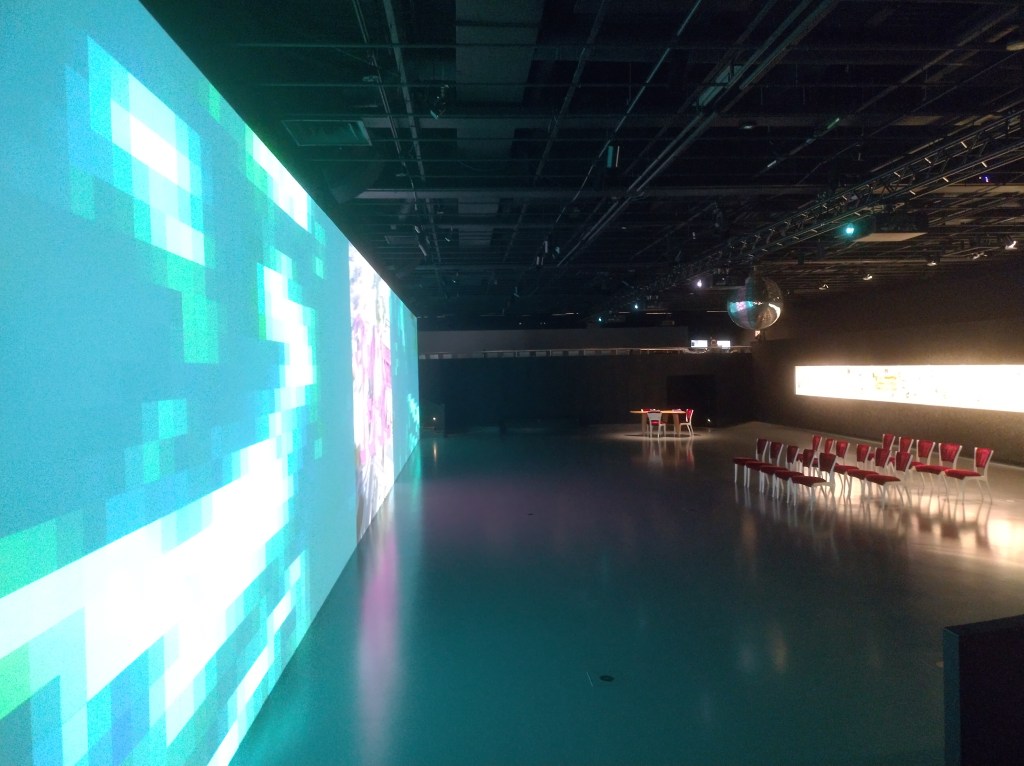
For all its contributions and provocations, the exhibit Devade: Prague’s Architecture Amidst Austerity and Disco might appear most interesting at the moment when the visitor leaves it. Not, of course, in any pejorative sense of being glad to put it behind oneself, but instead as a confirmation of its – literal – extramural importance, its engagement with the context outside and its confrontation of past with present. And in this moment, a confrontation of several pasts and presents that poses more questions than, admittedly, the exhibition itself even attempts to answer.
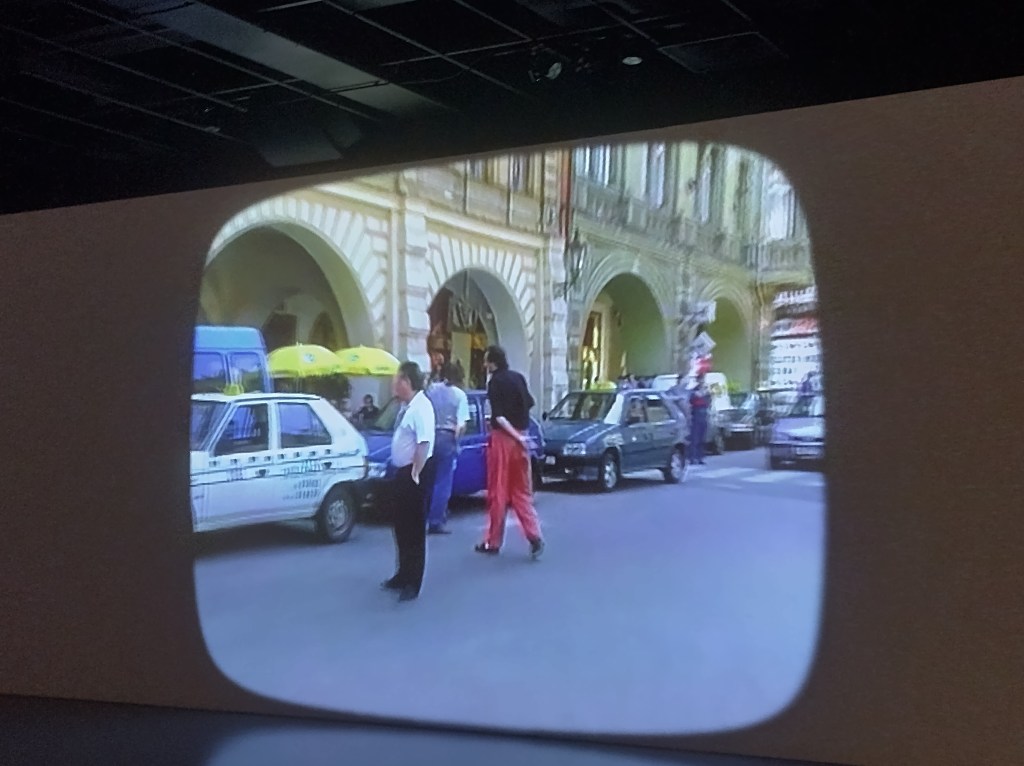
“Devade”, in current Czech slang, refers to the decade of the 1990s, understood in this instance as the “long 1990s”, from the end of Communist Party rule in late 1989 to the official European Union membership of most of the former Warsaw Pact states in May 2004. A time of seismic change: the dissolution of the command economy, the privatization of the state construction sector, the rise of private entrepreneurship and foreign investment, the appearance of the international starchitect and the DIY market. Not to mention the unique stylistic manifestations, from historicist postmodernism through high-tech up to complete ostentation, often seen as a reaction to the material and intellectual stagnation of Czechoslovakia’s much-decried “normalization” era (1970-1989) after the Warsaw Pact invasion of 1968.
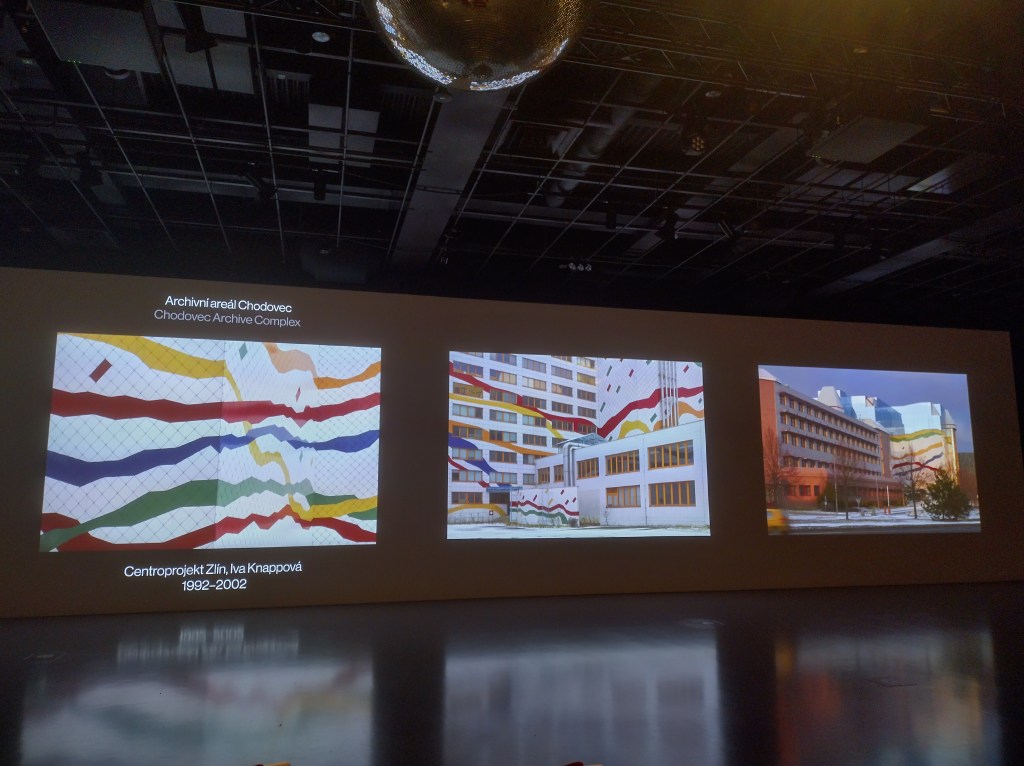
Curated by Matěj Beránek, Jan Bureš, Radek Šrettr Úlehla and Adéla Vaculíková – by their own admission, all from a generation too young to have participated directly in the 1990s and thus unburdened by its debates – the exhibition aims to examine the decade outside any received ideas and ingrained prejudices. It presents a selection of thirty Prague buildings and realizations: landmarks as unavoidable physically as historically (Vlado Milunić and Frank Gehry’s Dancing House, or the long-derided if increasingly iconic Hotel Don Giovanni, raising its turrets high above the New Jewish Cemetery and Kafka’s grave), lesser-known but often more interesting works (the MUZO office building by Stanislav Fiala or the National Archive by Iva Knappová), or even transport infrastructure (the above-ground tube and new stations of metro line B). And equally, structures like the Křižík Fountain and the new musical theatres at the Exposition Grounds, long overlooked by critical attention for their unabashed appeal to mass-culture taste.
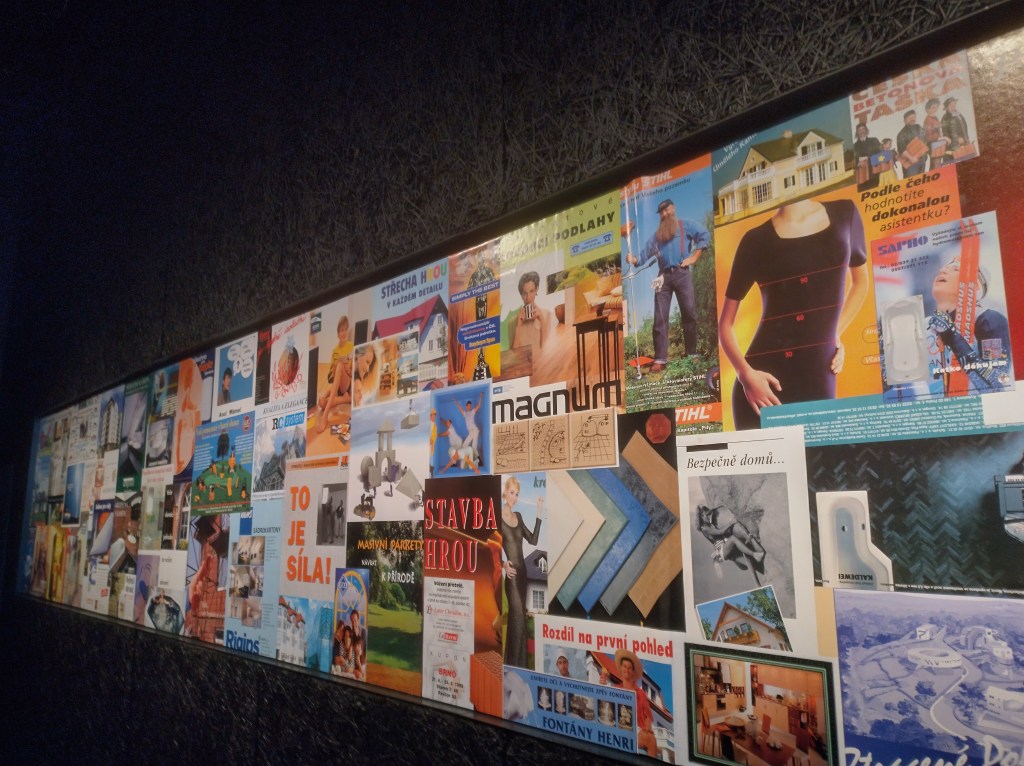
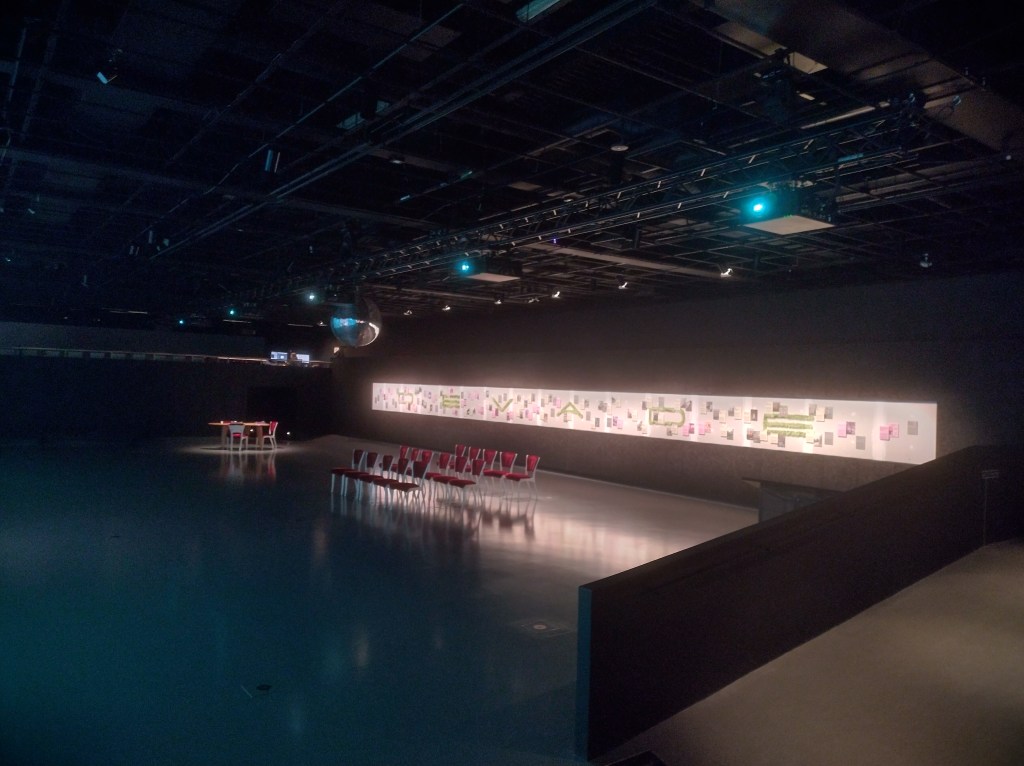
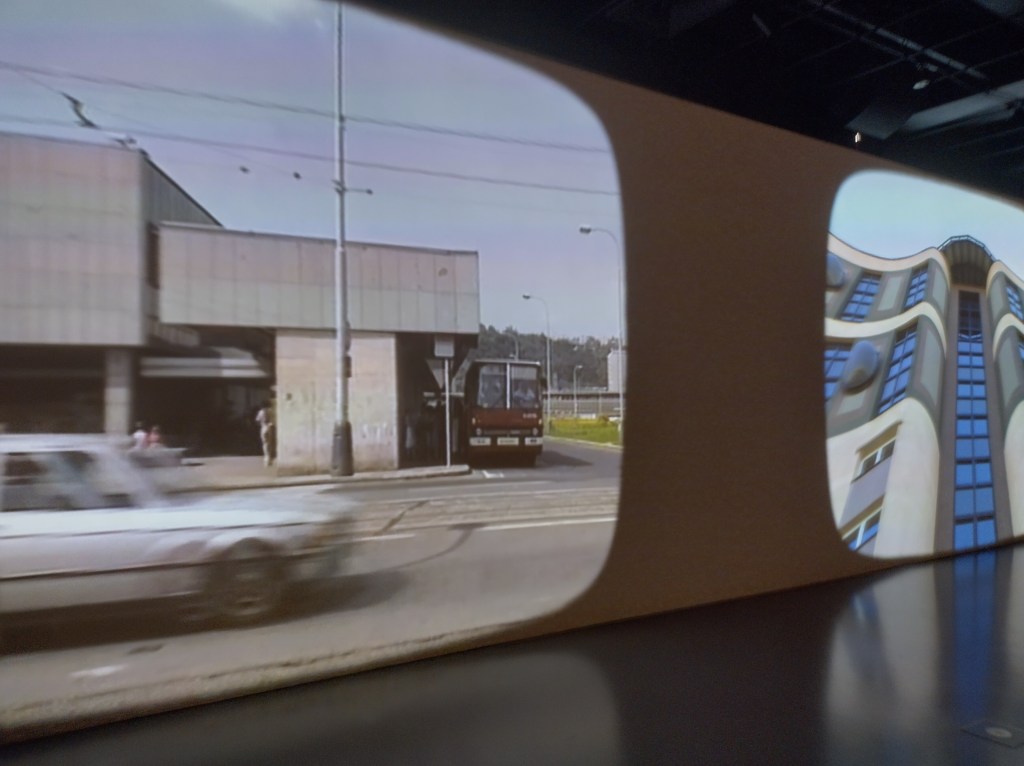
However, the most striking aspect of the exhibition, upon entry, is its visual form. The immediate impression is of darkness: set inside the enormous windowless display space of Prague’s Center for Architecture and Metropolitan Planning (CAMP). Two thin bands of illuminated displays occupy one side wall – historic real estate and building-material advertisements – and the front wall – a terse chronology of the decade in architecture, development and planning. Across from it is the main visible element, a video loop projecting scenes of Prague in the 1990s, interspersed with brief interviews of key personalities from the decade. The central part of the space is left largely empty, except for several rows of chairs – fittingly period-appropriate, the “Olga” design that Bořek Šípek created for Prague Castle during Václav Havel’s presidency – and of course the mirrored disco ball, hanging from the exposed infrastructure of the ceiling.
Understandably, the exhibition space itself creates this situation: the very antithesis of the traditional white cube if not, in a possible over-interpretation, even a refined critique of its high-modern sacralization of the objects on display. In another sense, though, the darkness and the flickering illumination create an unexpected impression of historicism, a genuinely period-grounded match for the subject matter. Some viewers might recall the salient twentieth-century media of cinema and television, the Plato’s cave of captive eyes concentrated on the illusory light-play of distant visions. Or perhaps a closer analogy is a major spatial genre of the 1990s, if almost entirely vanished today – the casino-bar with the sinister glitter of its one-armed bandits in twenty-four-hour dark, Benjamin’s phantasmagoria of time converted into a narcotic….
And yet, and yet… looking more closely at what is on display, it is hard not to feel disappointment. The advertisements, in their clutter of naïve typography and cheap clip art, may present an accurate sense of the visuality of the time, yet provide little explanation of the economic realities of privatization, international capital, or outright fraud behind the glossy surfaces. The video clips depict 1990s Prague accurately if invariably resorting to the easiest cliches (global advertising logos, Škoda Favorit taxis, purple tracksuits); the images of key cultural figures (Václav Havel, Milan Knížák) or architects (Alena Šrámková, Martin Rajniš, etc.) occasionally voice useful soundbites, but again, the impression is as if someone else had grabbed the TV remote and were compulsively flicking through the channels.
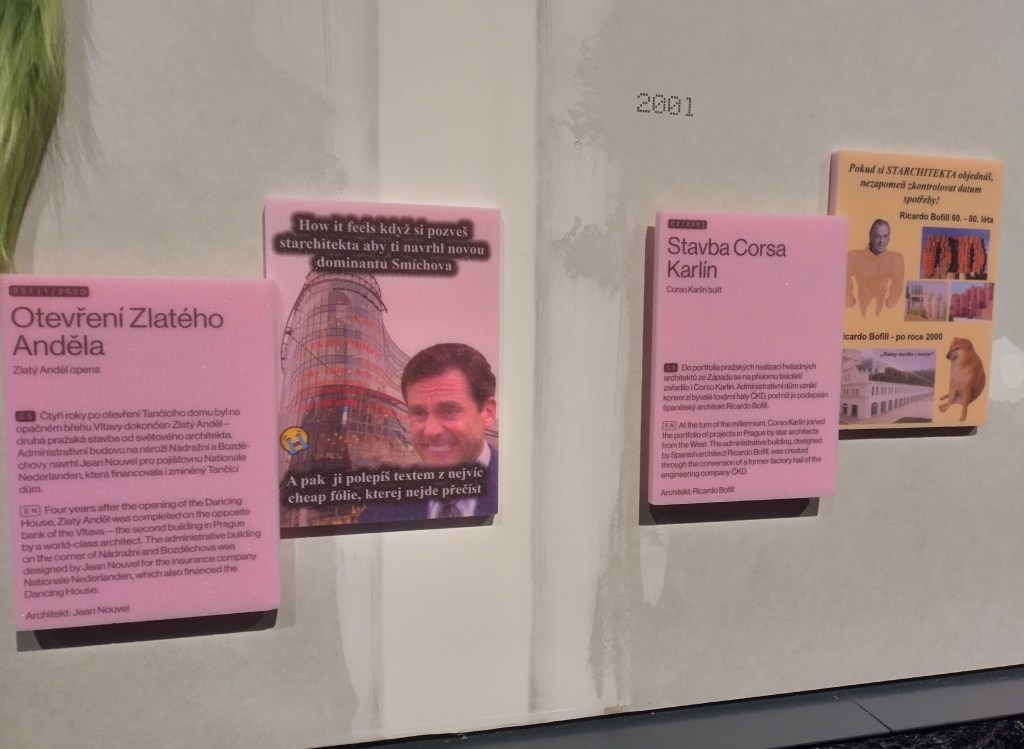
Worst of all, the display wall combines its chronology with an interminable series of puerile, derivative adaptations of cyberspace memes – invariably written in that English-filled reverse Nadsat all too common on Czech-language social media, the plague of “sprosté vurdy” striving to appear sophisticated. The line between effective popularization and cringy pandering is unquestionably a delicate one; architectural in-jokes spatchcocked into an imitation of global meme culture evades the question by combining the drawbacks of both sides: insulting the viewers’ intelligence while remaining strongly elitist in its cultural references. If, as the curators state, the primary intention is to offer a chance for rehabilitating Nineties architecture as worthwhile heritage, this childish snarking is distracting if not outright counterproductive.
The same, fortunately, cannot be said of the accompanying publication, a series of compelling and well-founded studies of the thirty buildings covered in the exhibit. Already, several excellent publications have appeared from Czech scholars on the era, several even available in English, and the printed version Devade aptly complements the list. Yet here as well, the approach toward what is regarded as architecture remains highly conservative. The Prague Metro has long been regarded as an architectural work, even a revolutionary one; large-scale commercial projects like gated satellite communities, in this case the American- suburb clone of Malá Šárka, are the closest examples in the exhibit to anything like vernacular building.
By contrast, the private residences known as “businessman Baroque” (podnikatelské baroko), a defining element of Czech suburbia, appear only as marginal images, and seem unlikely ever to attract the enthusiastic reception, say, that the US Victorian balloon-frame extravaganzas won in the 1970s, let alone any possible parallels with the remittance architecture of Latin America or Europe further south and east. Informal construction like the open-air markets (now seriously endangered) lie entirely outside the purview, though it might be fascinating to compare the scrap-metal aesthetic of a Vietnamese merchant’s market stall to the raw industrial materials, the “explicit incorporation of their harshest edges and detritus” of Frank Gehry’s early career before the Dancing House.
And if there is one structure unquestionably missing from the decade’s end, it would certainly be the infamous Matiční ulice wall in Ústí nad Labem: the concrete barrier purportedly raised as an anti-noise baffle between a Roma ghetto and a white suburb in 1999, only to be dismantled within a few months after considerable national and international protest. No, not for any stylistic or technical breakthroughs, but – as much as any starchitect-production – as an import of capitalist-world spatial racism, following in a long American tradition. Or even as an ironic echo of Gehry’s hostile “proletarian or gangster facades” (ibid.) in Reagan-era Los Angeles, reappearing as harshly serious exclusion-technologies in a rust-belt periphery far from the metropolis….
For after all, the exhibit’s concentration on the capital city is only one part of its shearing the display items of their deeper social, spatial, physical context: the Balzacian tales of great fortunes and their great crimes, deindustrialization and working-class trauma, racial exclusionism along with the strengthening of economic inequality. A smooth, unimpeded succession of images, freed of the weight of distasteful materialities; we enjoy the sense of open possibilities and stylistic diversity, yet are spared any confrontation with how the events of the 1990s sowed metaphorical dragons’ teeth of increasingly harsh classism, racism, xenophobia.
And even the narrative arc of the exhibit, suggested by the two polarities in its title, only presents the external stylistic discrepancy between the “austerity” of an increasingly rigorous and minimalistic neo-Modernism against the “disco” of flashy, often garish postmodernism. As we look back to what seems merely a harmless pluralism, we are never once reminded of how aesthetic taste, as by now should be evident, is never an innocent category: it is inevitably a matter of asserting power, imposing superiority, performing discrimination in the garb of discernment. Memorialization of the 1990s as unbounded optimism and post-historical celebration, almost a frivolous satyr-play after an unrelentingly grim tragedy of totalitarianism and genocide, may be an understandable reaction to our current predicament of vertiginous hypercrisis and authoritarian threats. Yet nostalgia can be as dangerous as it is comforting.
Which, in turn, brings us back to that defining moment at the beginning of the present essay: the point of exit from the exhibit, the return to the world outside and the integration of all the problems posed within that dim TV room into the situation that confronts us. The headquarters of CAMP happen to be the “Prager cubes”: Karel Prager’s striking monument of Second World Brutalism atop the World War II bomb site near the rebuilt Emmaus Monastery, just before its planned closure for an ambitious restoration in the latter part of this year.
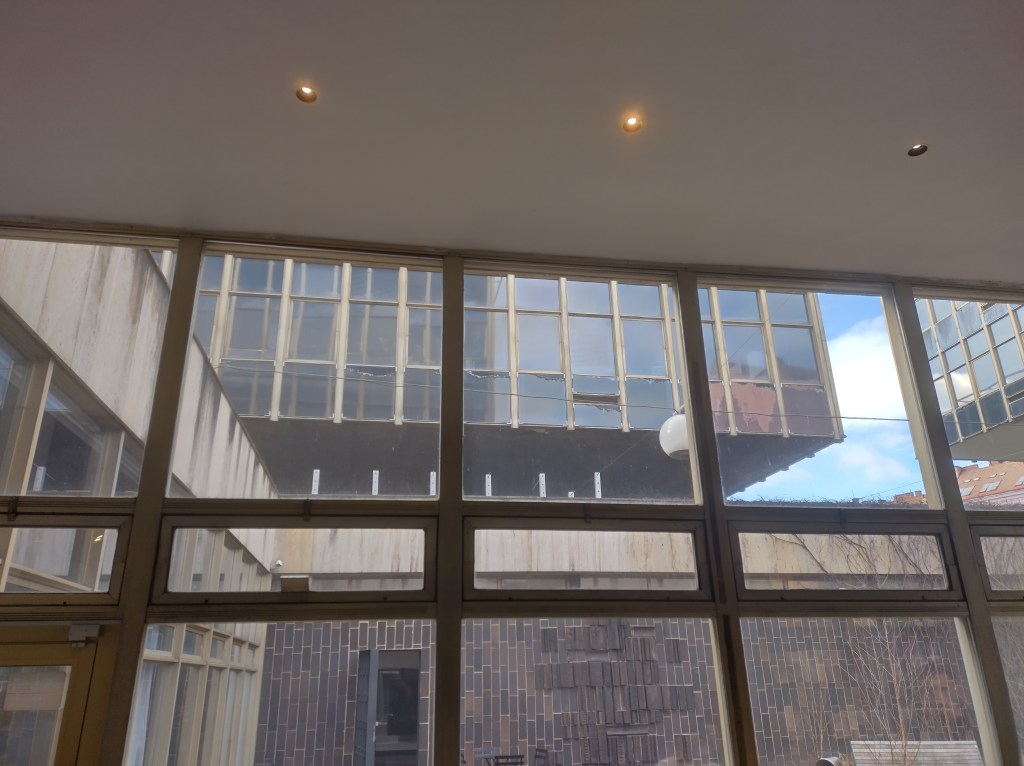
Not long ago –in the decade under consideration – the Prager cubes were the subject of open distaste: a hideous imposition on the historic cityscape, the crystallization of Bolshevik disregard for tradition, spirituality, beauty… Now, rather than an irretrievable black hole of cultural barbarism, they are regarded as a valid landmark and Prager as a major voice of his generation. Placing the architectonic heritage of the 1990s in this setting may well have been largely the result of happenstance. Yet, emerging from the phantasmagoric dive into a vanished century, we are brought from our time-narcosis into an immediate confrontation with the present: the courtyard, still in its original material with the black coating peeling from the glass panels and the exposed concrete still darkened by time, while stylish youths pound their laptops in the café below, is a sobering lesson.
Here, reality intervenes, relating to us a sermon in stone (more accurately in cement and rebar) far more radically deconstructive, and in some ways far more brutally cynical, than the postmodernity of the last century could ever have imagined. No innocence, no beautiful liberation from the weight of historic horrors; only the recurrence of new problems as the years pass. Yet if the 1990s could still offer any lesson, from the most unlikely of sources, it might be precisely such a surreal conjunction, as if imagining a ghostly echo of Walter Benjamin in a recollection of a downmarket herna bar, that some faint dream of hope might be possible, despite all the evidence against it.
 concrete eye
Leave a comment