The Danube
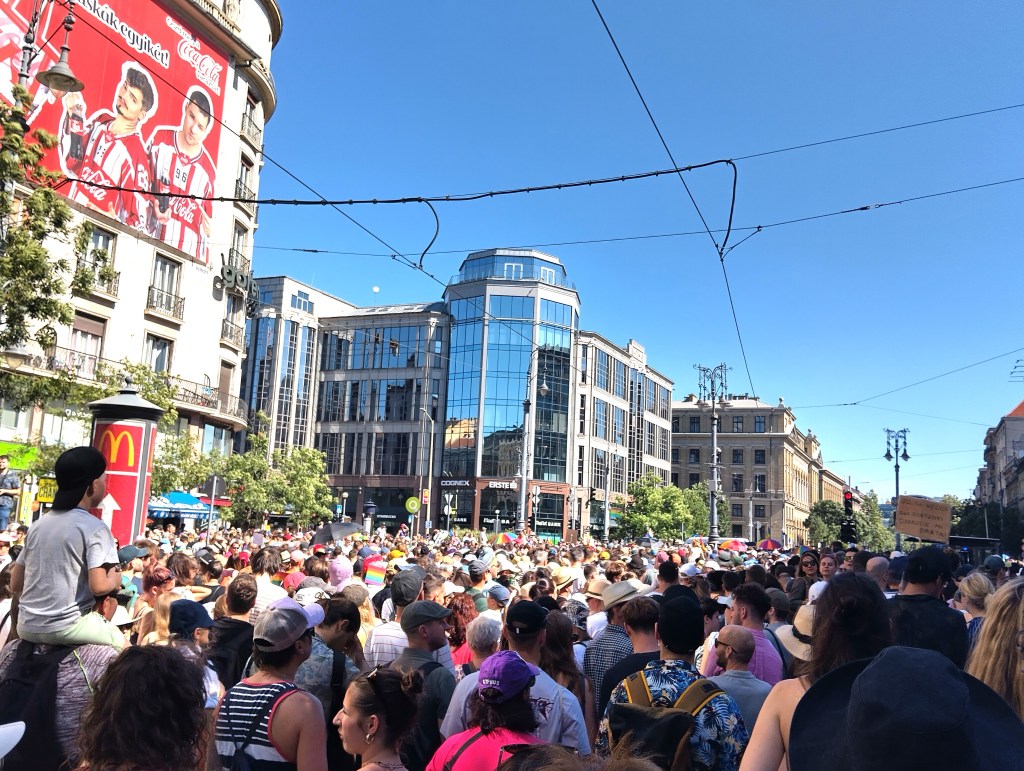
Ever larger, the crowd continues toward the next intersection: Astoria, from the 1914-vintage hotel at the corner, evoking its atmosphere of luxury through the name of the then-legendary American oligarch and beaver-slaughterer. Here is the first change: the next section of the Inner Boulevard is blocked; we will now be turning right to cross the Danube on the Elisabeth Bridge. From among the other marchers, I hear rumours that the change was made at the last minute, to avoid the plethora of security cameras along the next stretch. Now, the route follows along Kossuth Lajos utca. Under any other circumstances, a howling canyon of high-speed traffic charging straight through the midpoint of Pest. Today, moving slowly and on foot, every detail of the tragic blackened facades is visible.
Toward the bridge, sardonic laughter greets the short section of the same roadway leading onto it: Szabadsajtó utca, or Free Press Street. But enough of cynicism for now, we’re ascending upward, above the Danube. And when finally standing on the bridge itself, a look back. Nothing but more of the Pride march, filling the street, fully matching the over-heroic scale of the metropolis itself.
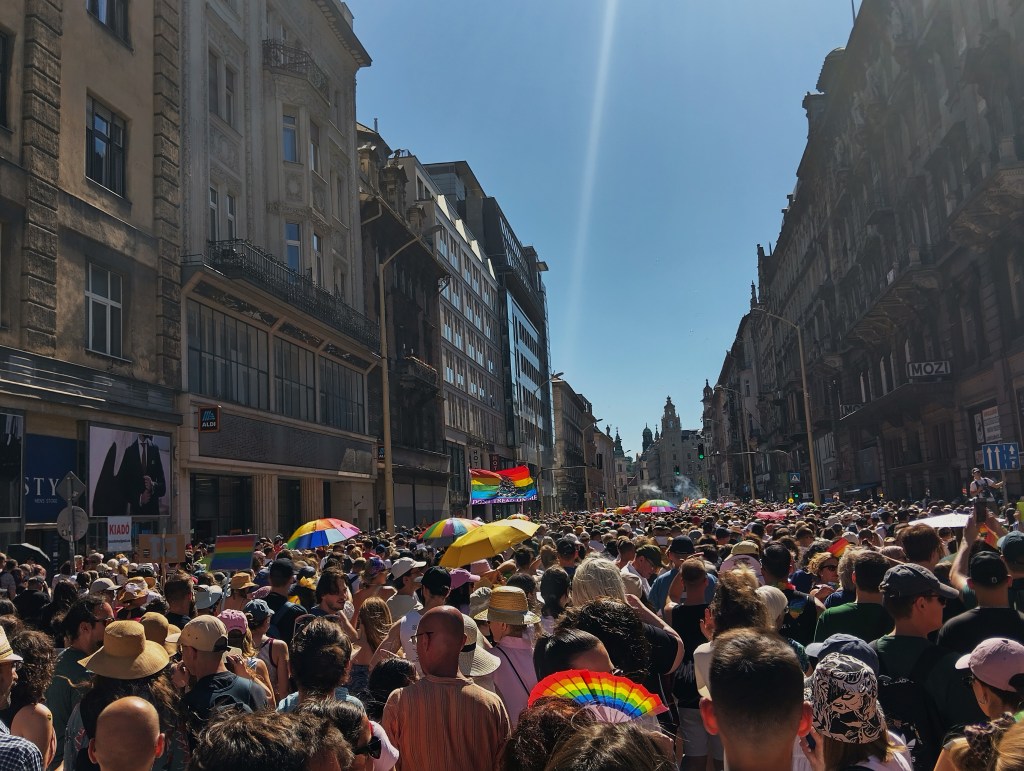
Around me, everyone is estimating how many people might be with us, some optimists even predicting a hundred thousand. As it happens, the accepted figure was twice this number. For the historical record, against any government or media distortions, it is worth noting that I have so far heard Hungarian around me almost exclusively, with the rarest of exceptions. Spirits are visibly higher, not only from the exhilaration of crossing the bridge at walking pace, without the oppressive roar of car traffic, but even more from the sight of the tens of thousands in front and behind.
Ahead lies Gellért Hill. The statue of St. Gellért, the 11th-century bishop Gerard of Csanád, has an enormous pink triangle at its feet. All up the stairs to the figure are sympathisers, waving their own rainbow flags. More police here than elsewhere – but only because for the first time, there are counterdemonstrators, a scant handful standing by the northern off-ramp. The dolomite cliff provides shade, and even the cooling from its rock. Passing by the tiny mineral springs in its side – invisible from the cars that usually rush past – I again think of the fortunate side effect of giving the street to people over private metal pods.
At the Rudas Baths, all the bathers on the upper deck are waving to us. Somehow, we’ve come up against another sound truck; the DJ has just started spinning “I Kissed a Girl”. I try hard to enjoy the moment and not think of Katy Perry and the idiotic Bezos rocket excursion…. The shade is vanishing into more sunlight, and on the Freedom Bridge is a thick wall of police, most of them wearing their characteristic raspberry berets. I look away from their scowls to the imposing Gellért Hotel at the hill’s base, marking the beginning of the end for the march.
Coda
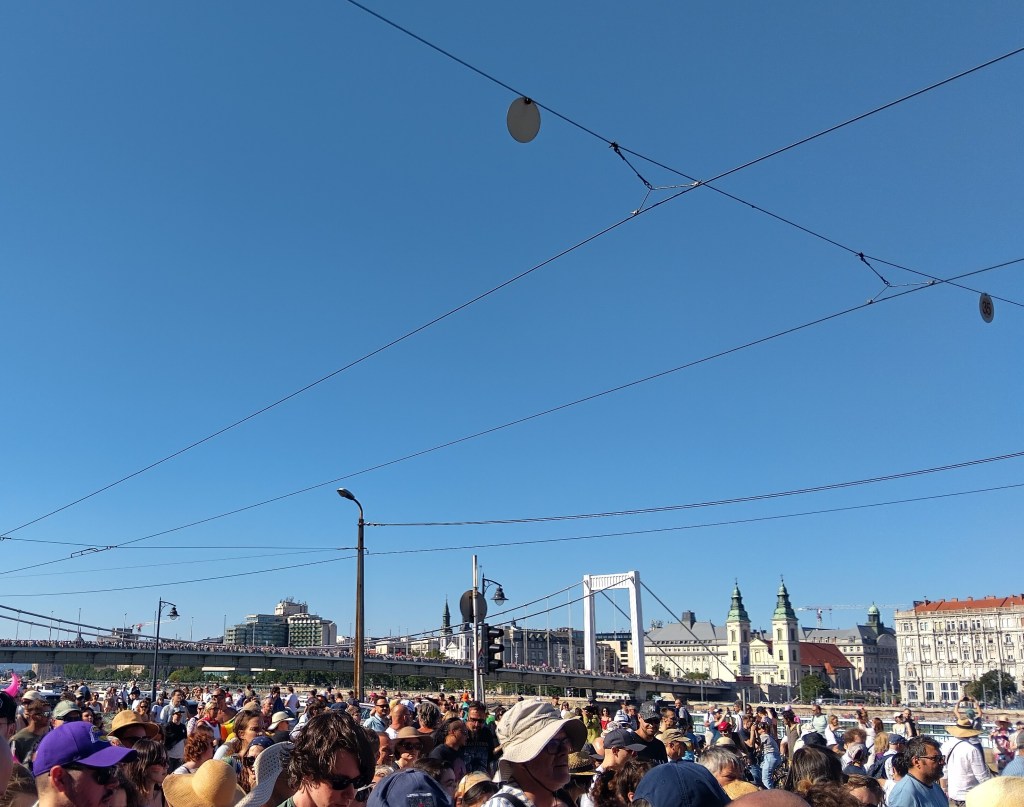
The endpoint of the march, on the embankment, boasts only a soundstage, a few tents for merchandise, and (mostly) queues for the port-a-potties. Knowing how many people are behind us, sensing still more than we can see, we decide to depart. I’m remembering an incident from a few years before: an outdoor concert by simultaneous Jumbotron broadcast of a vocal-symphonic work by Phillip Glass, near City Park on the opposite side of the Danube. In such circumstances, simply holding a performance in English – decades after 1989! – seemed a secret gesture of resistance. But it also meant the crowd at the end disgorging into the streets, overwhelming the transport links, as I recall well. So: keep moving….
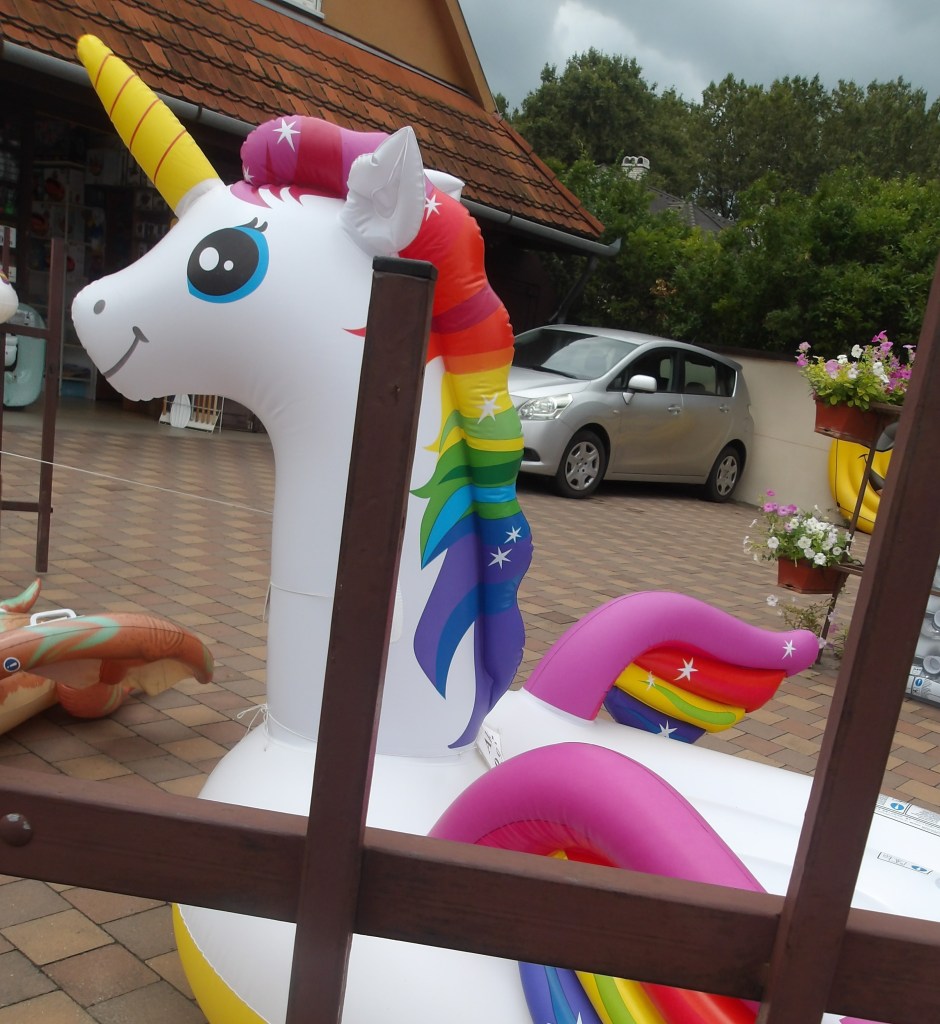
The crowd was still dispersing at nine that evening. What stuck with me was, though, one image: among the many items in rainbow hues – officially condemned by law as “LGBTQ propaganda” – was an inflatable unicorn with a rainbow mane. A common sight on Lake Balaton, a favourite piece of tourist tat – yet here transformed into a symbol of resistance. Was the 200,000-strong turnout a magical creature itself? No, this is not a situation where magic is necessary, or even desirable: Budapest Pride 2025 was real. More precisely, that day felt more real than nearly all my previous visits to “Orbánistan” over the past decade and a half, where conversations usually began with “what’s been shut down” or “who’s just died”, and the city itself, for all the pompous restoration projects or flashy new construction, seemed to be turning hollow. Now, the city itself – vast, grim, chthonic, haunted by past evils and persistent inequalities – had come alive once again, with the people in it taking centre stage.
Whatever those in power might say, cities are queer – sexually, but also transgressive in other ways, ethnically, politically, even chronologically in their fusion of past and present. Bringing the innate queerness of these boulevards to the foreground, championing the rights to individuality that urban spaces make possible: I had the great fortune to experience it during Budapest Pride 2025, and only hope my report can convey what it was like.
 concrete eye
Leave a comment