Demonstration 22.5 at Prague City Hall
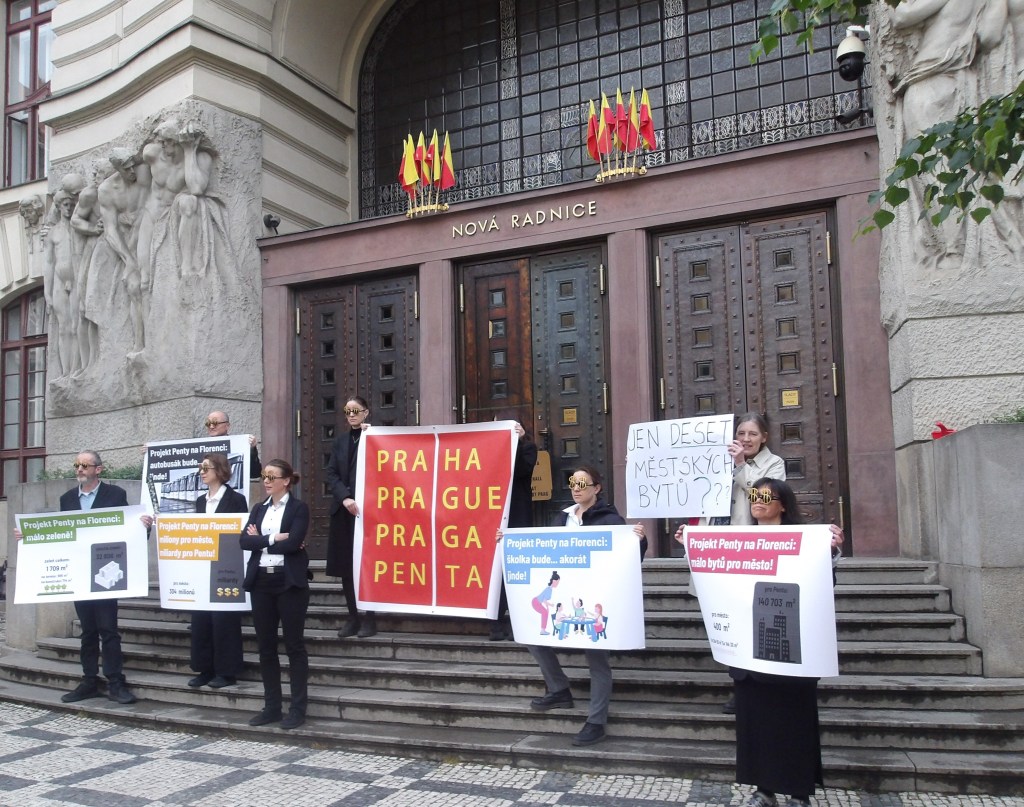
Eight-thirty on a Thursday morning: unusually cold for late May, drizzling rain slowly letting up. In front of City Hall on Prague’s Mariánské náměstí, all too often renamed by the city’s more cynical wits “Mafiánské”, a small group standing upon the steps as the council session begins. Black suits, dark glasses with dollar signs glued over the lenses, canvas banners asking questions that the city authorities somehow declined to ask.
The environmental group Arnika was organizing this “happening”, defying weather and public indifference, to draw attention to the development plans by Penta, a Bratislava-based private equity firm with a highly unsavoury reputation, for the Florenc brownfield in central Prague. Wedged between the 19th-century rail lines and the hulking presence of an earlier urbicidal intervention, the 1970s highway running along the eastern edge of the historic core, the land once largely occupied by railway outbuildings and the central bus station could represent an exciting opportunity for a forward-looking contribution to the urban landscape.
“Could represent”: under current political and economic conditions, a very uncertain formulation.
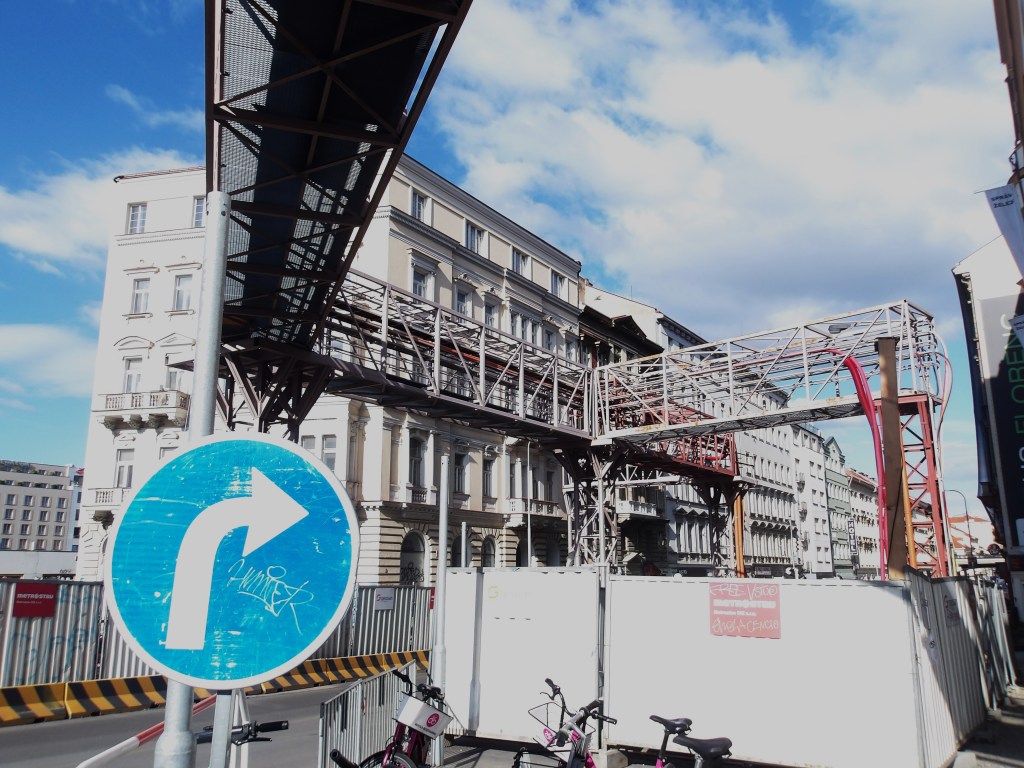
This section of land now belongs in entirety to Penta. Including the bus station – for the time being; the current plan assumes its relocation far from the metro stop, hidden behind the new construction. From all evidence, real estate with a high return on investment. And as a concession to the city, ten council flats and a promised kindergarten, nearly three kilometres distant.
And what does the future promise? More run-of-the-mill building production, unimaginative, leaving the looming environmental and social challenges largely unaffected. Beyond, that is, the ten council flats and proposed kindergarten, or a few green roofs. Worse, though, is the precedent set by the city in deciding to place the land entirely in private ownership – not to mention all the distasteful associations of the current owner, but even more the question of who could buy the properties from it. China, the Gulf oil states… or perhaps even Russia.
As one of the demonstrators mentioned, these rail and road lines are public infrastructure, vital infrastructure in the event of hostile military action – since 2022, not entirely unknown in this part of Europe. In the vast untamed flows of dubious money around the globe, where malign international actors and their shell companies could well be playing a long game while democratic states blithely assume business as usual, is it ever a good idea to hand the surroundings of such infrastructure over to untransparent capital?
Blandly smooth visions of a profitable urban machine are what the investors present; behind these AutoCAD simulacra lies the dim netherworld of the oligarchocene. Not the Cthulhucene, even if the outline of the Penta-held land recalls a stubby tentacle from Masaryk station up almost to the foot of Vítkov Hill. More the harsh disjunction between the surface visual boredom of corporate necrotechture and the hidden tales of sleaze running deep beneath, entwining wormy tentacles whose full course may never be known….
Yet at least the right to protest, to ask the questions unasked, remains open to us. And in the Thursday drizzle, the questions were asked. A tiny victory, but against the silences from both the private and public sectors, a victory nonetheless.
 concrete eye
Leave a comment