A review essay for the publication ATÚ: Automatické telefonní ústředny: Společnost, technologie, architektura. Eds. Irena Lehkoživová-Jan Zikmund, ČVUT-Výzkumní centrum průmyslového dědictví: Praha 2024)
The study and preservation of industrial heritage – a discipline poised between architectural history, collective memory, and the more-than-Heraclitean flux of economic and technological change – can be difficult enough in situations of relative historical calm and continuity. Still more vexing, though, is its position when facing the legacy of buildings and environments constructed in eras or political orders viewed by significant sections of the public as deeply tainted by injustice and oppression. For the past three decades, the paradigm has been state socialism of the Soviet variety, particularly in its European sphere. How to address the built legacy of state-driven modernization along Leninist principles: to reject it as a massive error to be expunged from history, or to integrate it into the present?
Of course, the question of Europe’s “really existing socialist” legacies – extending far beyond architecture – now appears much less unique than it did in the last years of the previous century. The “historical calm and continuity” of the previous paragraph has been significantly challenged everywhere, and most forcefully in the one-time heartland of the Cold War’s purported victors, the Anglophone world. Few thoughtful observers are likely to be as sanguine as previous generations about the stately homes of England and the cruel imperial exploitation that built them, let alone the slaveholders’ plantations and mansions of the US South. On the other side, a new generation of historians and researchers in post-socialist Europe, turning away from the “zombie socialism” of the political right and the antimodern animus of much “post-dissident” reflection, is now producing an impressive body of scholarship that is aware of the many ambiguities of life before 1989 without the uniform hostility once so prevalent.
And yet, as the readers of this forum are certainly aware, the threats of symbolic violence toward Second World spaces are unavoidable. Whether from illiberal-statist motives or merely the exigencies of capitalist profit, they continually face the ultimate rejectionism of demolition. For this reason, the publication ATÚ: Automatické telefonní ústředny: Společnost, technologie, architektura [Automatic Telephone Exchanges: Society, Technology, Architecture] is exceptionally valuable and indeed deserving of international attention, even though it has no parallel English edition (beyond the two-page English summary at the end). On one hand, Viktor Mácha’s impressive photography and the extensive compilation of historical images can be enjoyed regardless of linguistic knowledge; on the other, it provokes questions that resonate across boundaries of time and place – not unlike the disembodied voices of the old analogue telephone networks.
ATÚ is one of the many publications of the Research Centre for Industrial Heritage at the Faculty of Architecture of the Czech Technical University in Prague. At the same time, it thematically matches a series of additional publications on the architectural heritage of socialist Czechoslovakia reaching back almost a decade. Two key works available in English address prefabricated housing estates and cultural centres; understandably in a relatively small scholarly community, with some overlap of authorship among the publications.
While the historical scope of ATÚ covers the formation of the pre-WWII telephone networks in both Austro-Hungary and interwar Czechoslovakia (Jakub Potůček, chapters 01 and 01/1), the main timeframe is the socialist era: the postwar telephone system (Jan Zikmund, chapter 02), the state telecommunications design institute Spojprojekt (Jan Zikmund, chapter 02/2), the technical apparatuses of the switchboards (Jiří Suchomel, chapter 03), the aesthetics and comfort of the workplaces (Irena Lehkoživová, Jan Zikmund, chapter 03/3), the buildings themselves (Lukáš Beran, chapter 04), the recently demolished Central Telephone Building (ÚTB) in Prague (Lukáš Beran, chapter 04/4), and the productive Atelier 324 within Spojprojekt (Barbora Zavadská, chapter 05). Additionally, it contains an interview with two architects from Atelier 324, Jiří Eisenreich and Václav Aulický (Barbora Zavadská, chapter 05/5), and in conclusion, a consideration of the problem of preserving the telephone exchanges after their rapid obsolescence by the turn of the millennium (Petr Freiwillig, chapter 06).
In essence, the automated telephone exchange as an architectural typology emerged during the largely dismal era after the Soviet invasion of Czechoslovakia in 1968, cynically termed “normalization” and associated with cultural stagnation and political repression. Technocratic modernization programs damaged many cityscapes, from the near-complete erasure of the historic North Bohemian town of Most to the (only partial) urban clearance of Prague’s inner suburbs; what replaced them was overwhelmingly the “architecture of the crane-line” – uniform prefabrication of components as well as designs, not only in the residential tower blocks but even in many retail and public facilities. Paradoxically, the high-tech stylistics of the automated telephone exchanges in this era set them strongly apart from the standard construction output, And the architects themselves (note esp. the interview with Aulický, p. 174) today emphasize their extensive study of international journals and their own work (often in the face of considerable difficulties) to ensure that, at least in this one highly technicist field, Czechoslovak architecture could hope to keep pace with international standards.
It would be an exaggeration to call Spojprojekt an “island of positive deviation”, to cite the term of sociologist Soňa Szomolányi for a wide range of dissident or simply non-conformist efforts to evade the stifling public atmosphere of the 1970s and 1980s. Yet nonetheless, this group of realizations bears a disturbing complexity encoded within its social meanings, perhaps even incorporated into its physical fabric. And these questions reach beyond the stylistic or aesthetic, often into the explicitly political. Socialist or Leninist modernity unquestionably was a destructive force, yet the purported innocence of the pre-1989 “free world” is increasingly visible as a harmful delusion – not to mention the ever-burgeoning possibilities of anti-modernist, indeed openly reactionary stances and policies ensuing from the anti-Communist mentalities of the turn of the millennium. The failure of the “scientific-technical revolution” sought by normalization-era Czechoslovakia and other allied states should not imply that its neoliberal or nostalgic-authoritarian alternatives are necessarily morally impeccable.
And this disturbance brings us to a final consideration. One not mentioned in the book, though understandably so: while the main aim of the publication is to provide a rigorous scholarly appreciation of the automated telephone exchange as a category, it cannot but speak out in defence of the buildings as heritage worth consideration. And in the bruising, vulgar, reductive world of municipal politics, where heritage protection is applied or (more often) denied, it is the most pragmatic of argumentative strategies that survive. To stress the disturbing qualities of this heritage, indeed its strangely haunted character, would only harm its reception among the hardheaded, practical-minded public figures who make the decisions.
Yet all the same, architectural heritage or memory studies generally are disciplines where a strong dose of hauntology is not only appropriate but required. For the automated telephone exchanges, these “futures past” in Koselleck’s sense, disturb us not as ghosts but as skeletons, or rather the shed exoskeletons of the dead technologies they once contained. Not the disembodied – after all, that was the function of telephoning in their century – but the outer casing eviscerated by the exigencies of time. Not the disturbance of the “place of an absence… discontinuity, alarm and silence”, in Avital Ronell’s words crossing the divide from a past age, but more the jarring incongruity of Wintermute announcing itself to Case by – making all the payphones in the spaceport ring as he passes them.
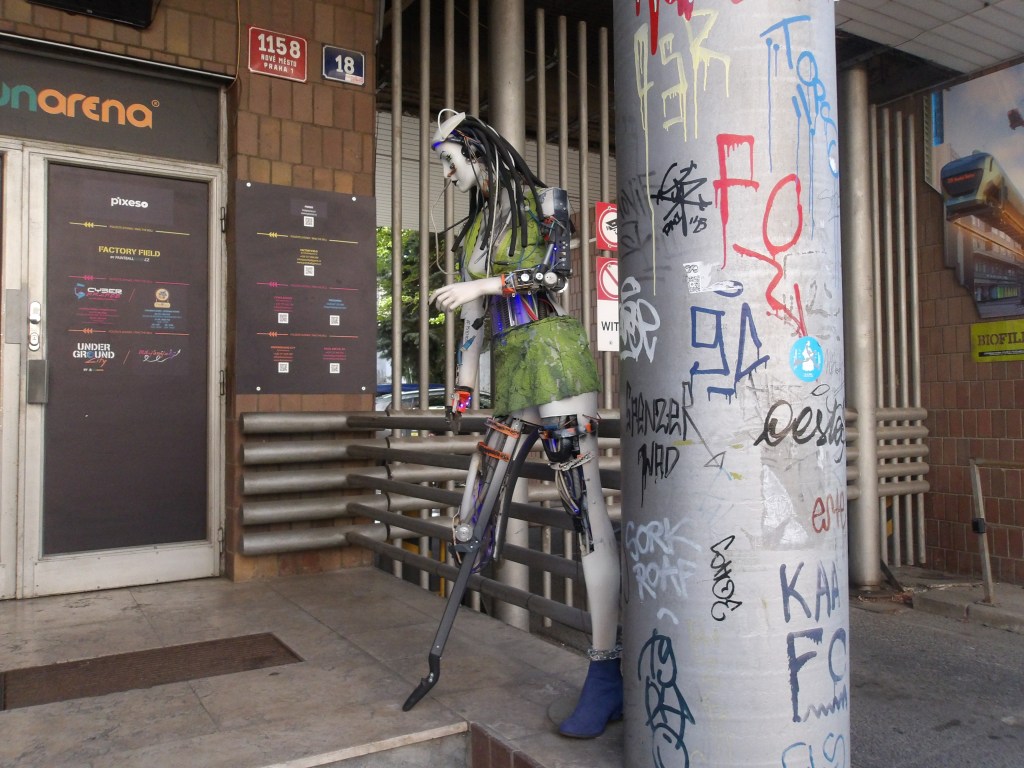
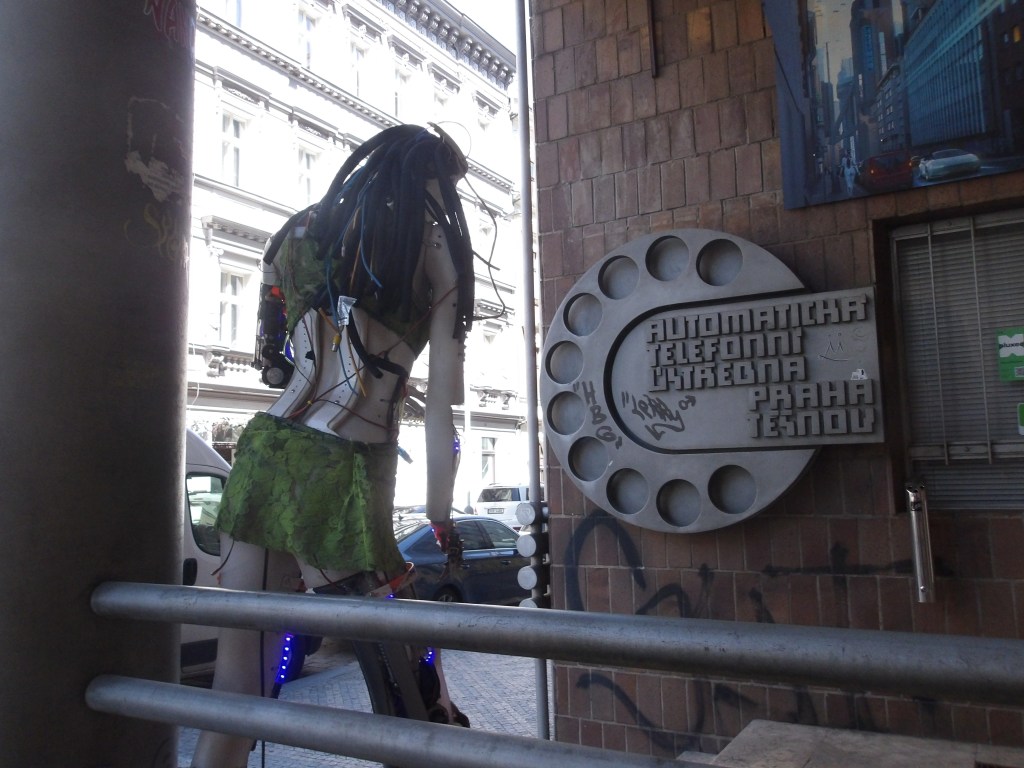
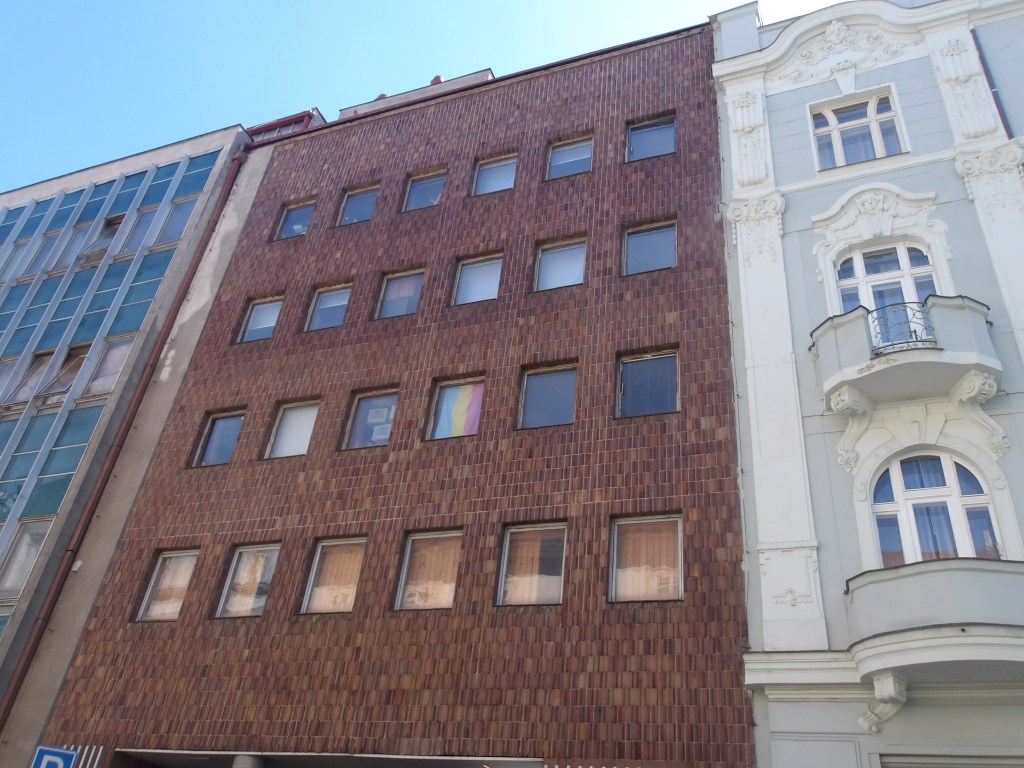
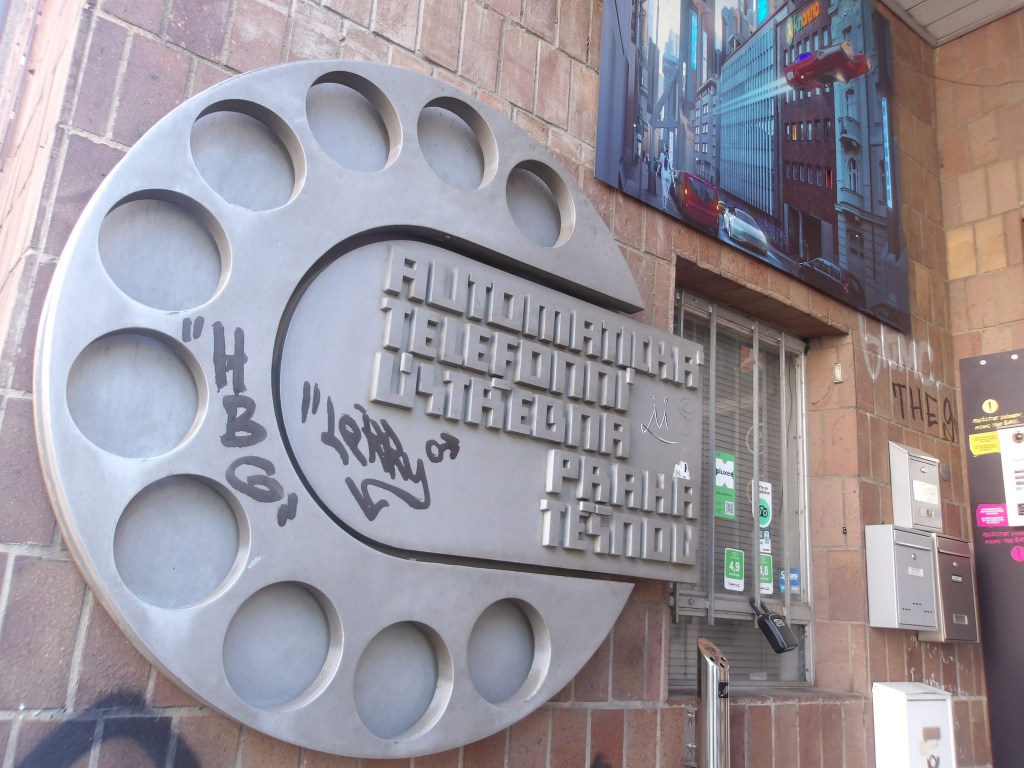
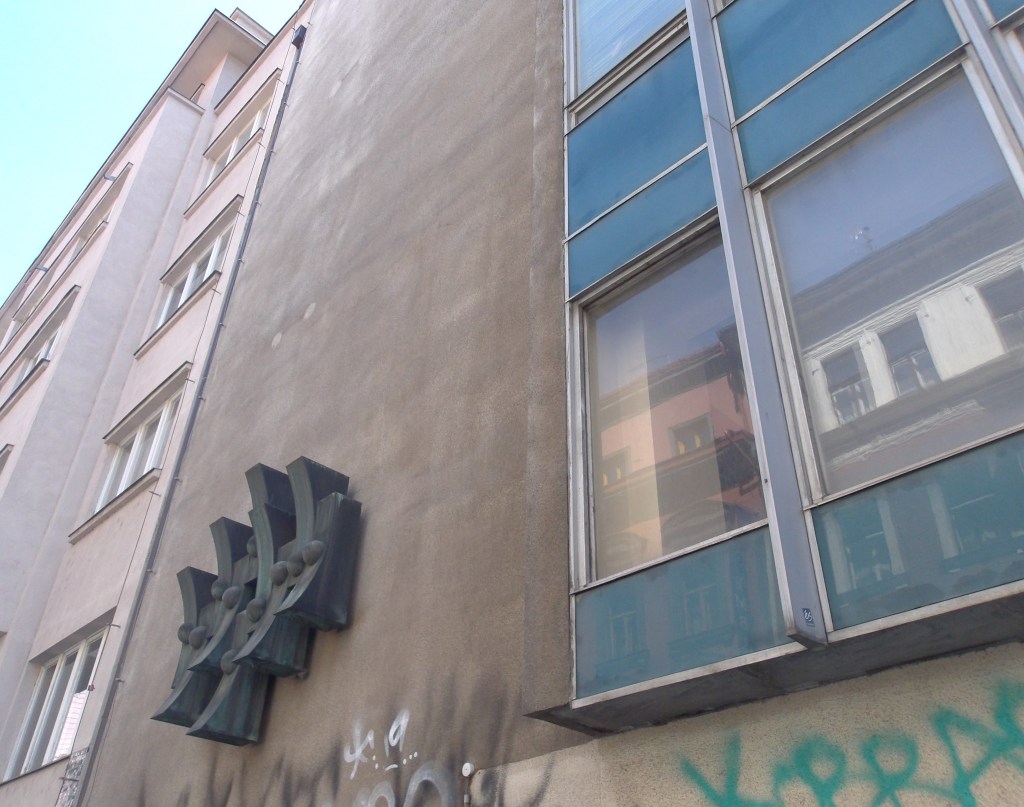
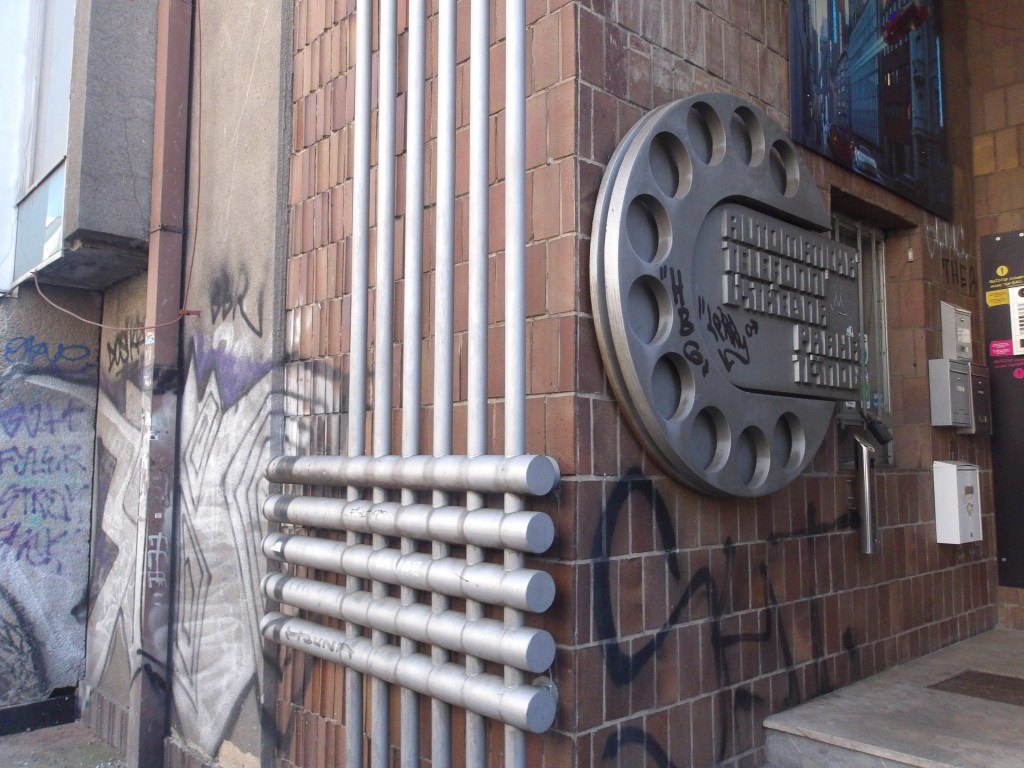
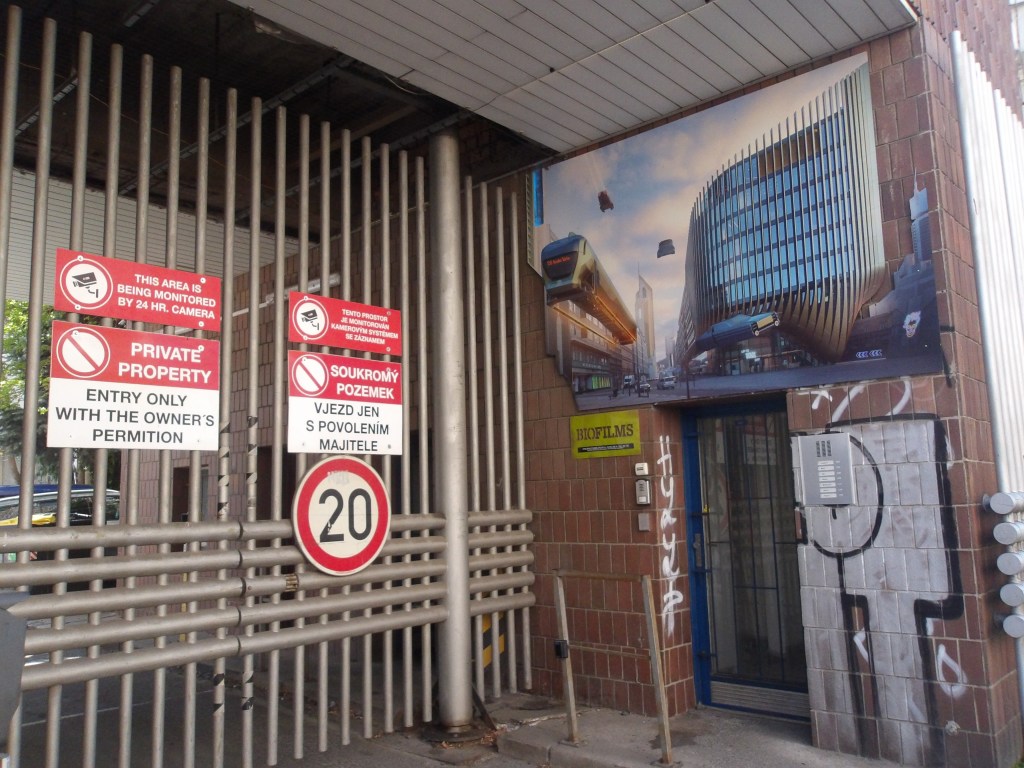
The illustrations for this review depict one of the surviving yet threatened telephone exchanges in Prague, the Těšnov exchange. Only a few steps from the land haunted by one of socialist modernity’s greatest offenses against Prague’s architectural integrity, i.e., the demolition of the Habsburg-eclectic Těšnov rail station in 1985, it too faces likely destruction. For now, its exoskeletal envelope houses a laser game, announced to the street with a sexy cyborg; could it really be Molly from Neuromancer?
It makes you think. The virtue of ATÚ, in fact its chief virtue among so many others, is that this publication does the same.
 concrete eye
Leave a comment