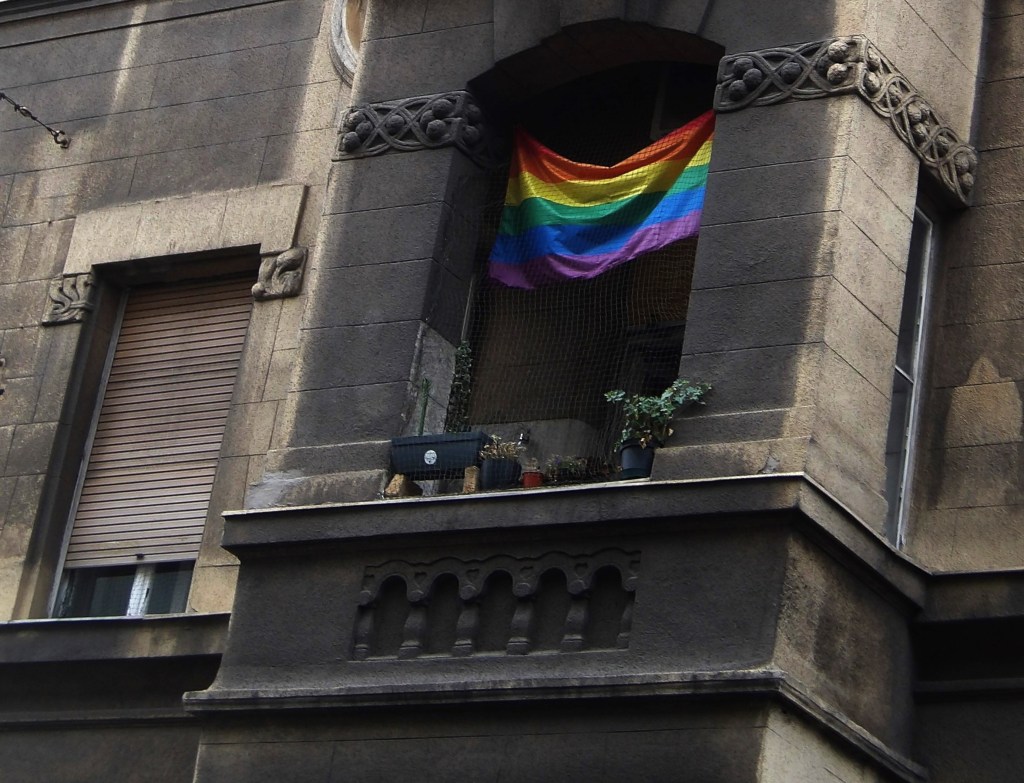
The editorship of Concrete Eye would like to express its profound distress at the recent decision by the Hungarian Parliament to ban all Pride events in Hungary, in Budapest and elsewhere, and use facial recognition software to identify and criminalize participants.
As a platform that engages with anthropocenic spaces – and cities in particular – Concrete Eye regards such LGBTQ+phobic measures not only as flagrant and grotesque violations of human rights, or as profoundly disturbing echoes of political realities in our region before 1989, but equally as a matter of its professional and activistic purview. In other words, the current queerphobic legislation in Hungary is as much an urbanistic question as a legal one.
The vicious onslaught by Hungary’s current government on queer visibility in public space should be understood – and treated by both professional and activist communities – as a question of the right to the city: of the human (or other) actors among the built fabric(s) that give the urban environment its vital life. For many years, both state repression and market forces have weakened the role of the Central European city understood through its human “fabric”. In the case of Budapest, the brutal anti-homeless laws of 2013, even though fortunately shifting in a far more promising direction under the present municipal government, seem by now a test run for a wider assault on the rights to urban space.
From the heights of camp fabulosity in a Pride procession to the deliberate self-abjection of oppositional subcultures pre-1989 (for instance, Hungary’s csövesek of the 1980s), the right to public difference is essential for urban life, yet equally for the understanding, planning, or formulation of urban (physical) spaces. And for urban social movements, or indeed anyone with a sense of basic justice, it is necessary to make this call for public solidarity with Hungary’s embattled LGBTQ+ population: to speak out in their support, to integrate queer presence and queer spatialities into their practice, or if necessary to consider the necessity of placing themselves physically in Budapest, facing off against police software or clubs, in their defense.
 concrete eye
Leave a comment